
By Mike "Jabs" JaballahFounder and Director. Location Sound Recordist.
Underwater volcano sounds are mostly deep booms, rumbles and long bursts of noise, much of it sitting at the bottom edge of human hearing. They're recorded with hydrophones, which are microphones built for water, left on the seafloor or dropped over the side of a ship.
The catch is depth. A popular field hydrophone like the Aquarian H2a is rated to under 80 metres, while many underwater volcanoes sit hundreds of metres down. Reaching them takes research hydrophones rated to thousands of metres. And nobody dives in to get the take.
What does an underwater volcano sound like?
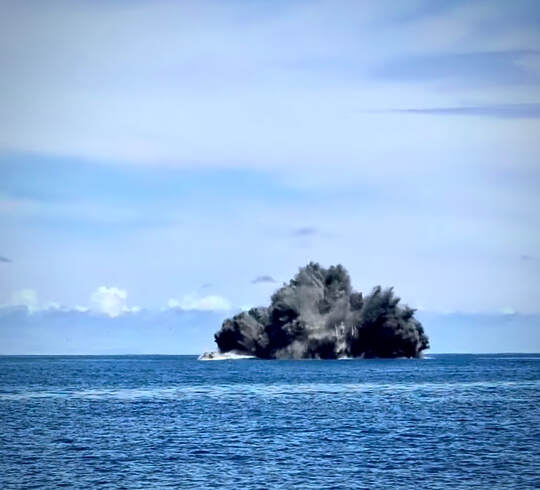
An underwater volcano sounds like deep, rolling explosions and rumbles, often in bursts that last minutes. Most of the energy is very low. At one well-studied volcano, the eruption sounds peaked around 30 Hz, close to where human hearing gives out at roughly 20 Hz.
That volcano is NW Rota-1, a seamount in the Mariana arc whose peak sits 517 metres below the surface. Its gas-driven explosions came in bursts of two to six minutes, with sound between 1 and 80 Hz, according to the University of Rhode Island's Discovery of Sound in the Sea. Each burst started suddenly, built for about 30 seconds, then jumped up again and held.
The sound also travels absurdly far. Water carries low frequencies much better than air does, and researchers from the Alaska Volcano Observatory and the USGS picked up signals from the Ahyi seamount on hydrophones off the coast of Chile, roughly 15,000 km (9,600 miles) away.
How do scientists record underwater volcanoes?
Scientists record underwater volcanoes with hydrophones placed in the water and left to listen. Some are moored on the seafloor near the volcano for months. Others are lowered from a research ship or carried by an underwater glider.
The best-covered example is Axial Seamount off the Pacific Northwest. MBARI calls it the most active underwater volcano known, with eruptions in 1998, 2011 and 2015, and the most heavily instrumented. Two broadband hydrophones on the seafloor there recorded a month-long eruption in 2015.
The scale can be huge. In the Lau Basin in the South Pacific, a NOAA team deployed an array of 13 fixed hydrophones across 126,000 square kilometres that recorded continuously for 1.3 years, then added four closer moorings and a hydrophone-carrying glider around the West Mata volcano.
Notice what's missing from every one of those setups: a person in the water.
Can you dive near an underwater volcano to record it?
No. The people who record underwater volcanoes for a living put the hydrophone in place and stay out of the water. An active vent can blow, slide or bury everything around it with no warning.
NW Rota-1 shows why. A hydrophone there logged months of small rumbles, then a huge, loud sound that ran for nearly four days. When the team came back in early 2010, a landslide had buried or carried away nearly all of their equipment. The hydrophone was one of the few things that survived. A diver would not have.
So the rule is simple. Leave the hydrophone. Get out. Let the gear take the risk.
What gear do you need to record underwater volcano sounds?
You need a hydrophone rated for the depth, a recorder that can power it and run for a long time, a way to moor or weight the line, and a way to find it again. A normal microphone won't do the job.
That last point catches people out. Put a regular mic in a waterproof case and it still performs badly, because air mics are built to match air, not water. A hydrophone is designed to match water, which is why it hears what a normal mic can't.
Which hydrophone should you use?
Use a field hydrophone for shallow water and a research hydrophone for anything deep. The split matters for volcanoes, because the hydrophone most recordists can buy can't go anywhere near the depth most underwater volcanoes sit at.
| Hydrophone | Type | Frequency range | Rated depth | Good for |
|---|---|---|---|---|
| Aquarian H2a / H2a-XLR | Field | Below 20 Hz to above 100 kHz claimed; flattest from 20 Hz to about 4 kHz | Under 80 m | Lakes, rivers, reefs, shallow coastal work |
| HTI-96-Min | Research | 2 Hz to 30 kHz | 3,048 m | Deep moorings, ocean-bottom systems, long deployments |
Aquarian rates the H2a for an operating depth of under 80 metres. High Tech Inc rates the HTI-96-Min to 3,048 metres, with a response from 2 Hz to 30 kHz, and it's widely used in the seismic industry for ocean-bottom systems. That 2 Hz floor is the point: it reaches well under the 30 Hz where volcanic rumbles peak.
Two practical things from field recordists. Cheaper hydrophones are often built around piezo discs, which have a limited frequency response and a noticeable resonance. And an Australian field recordist testing the H2a-XLR in a lake found it was more sensitive downwards than to the sides when hung by its cable, so angle it towards what you want to hear.
Can you plug a hydrophone into a field recorder?
Yes, if it has the right connector and power. The H2a-XLR plugs into any standard XLR mic input, but it needs phantom power to work, and Aquarian says not to exceed 48V. The plain H2a uses a 3.5 mm plug instead.
Aquarian's H2a-XLR guide says any standard phantom supply will work. So a field recorder that supplies 48V phantom power, like the Sound Devices MixPre-3 in our location sound equipment hire range, is the simplest topside setup for shallow work. Hydrophones are sensitive, so ride your levels and watch for overload.
What do research teams use for long deployments?
For long deployments, research teams use autonomous recorders: sealed units that sit on the seabed with their own batteries and storage, recording for weeks or months with no one attending them.
One coral reef study used Loggerhead LS1 recorders fitted with an HTI-96-Min hydrophone, powered by 12 D-cell batteries, which could record continuously for about 40 days. At volcano scale, the NOAA array in the Lau Basin ran for 1.3 years. You won't be setting one of those up from a weekend boat trip, but it's how the famous recordings actually get made.
- Depth-rated hydrophone, plus a spare
- Recorder with 48V phantom power
- Closed-back headphones for monitoring
- Mooring line, weight and float
- Beacon or surface marker for recovery
- Spare batteries and a second card
The NW Rota-1 team marked their hydrophone with a navigation beacon. If you can't find it, you didn't record anything.
What software do you use for hydrophone recordings?
Use a spectrogram tool to see the sound, an editor to cut it, and a spectral repair tool to clean it. A spectrogram matters more than usual here, because it shows you a 30 Hz rumble your headphones can barely reproduce.
Cornell Lab's Raven Lite is free and shows recordings as spectrograms and waveforms. It was built for bioacoustics, so long underwater recordings are its home turf. Audacity is a free editor with a spectrogram view for cutting and speed changes. For cleaning out boat and wave noise, a spectral editor such as iZotope RX lets you work on the noise visually rather than guessing by ear.
How do you set up a hydrophone?
Set a hydrophone up so it hangs still, away from anything you brought with you. Most bad underwater recordings are ruined by the recordist's own noise: the boat, the line and the waves, not the ocean.
Choose how it goes in
Moored on the seafloor for long recordings, or lowered from the boat for short ones.
Weight it and float it
A steady hydrophone gives you clean low end. A swinging one gives you thumps.
Kill the boat noise
Engines and pumps off while you record. A running engine will bury the frequencies you came for.
Record long
Eruptions don't run to your schedule. The longer it listens, the better your odds.
Mark it for recovery
If you can't find it, you didn't record anything.
How do you make the recordings listenable?
Speed them up. Because so much of an underwater eruption sits around 30 Hz and below, the raw file can sound like almost nothing on normal speakers. Raising the playback speed lifts every frequency with it.
The maths is simple. Double the speed and a 30 Hz rumble becomes 60 Hz. Four times the speed takes it to 120 Hz, right where laptop speakers and headphones can actually reproduce it. After that, a bit of EQ and gentle noise reduction for boat or wave noise is usually all it needs.
Always keep an untouched copy of the original file. A sped-up version is for listening. The raw recording is the actual data.
The thinking isn't so different from dialogue work on land: get the mic in the right spot, keep your own noise out, and record clean tracks so post has options. Our guide to boom mics vs lav mics covers the same idea above the waterline.
Questions we get asked
Can you hear an underwater volcano without a hydrophone?
Not properly. A regular microphone performs badly underwater even in a waterproof case, because it's built to match air, not water. And much of the sound is so low that you'd struggle to hear it raw anyway.
How deep can a hydrophone go?
It depends on the model. A field hydrophone like the Aquarian H2a is rated to under 80 metres. Research hydrophones such as the HTI-96-Min are rated to 3,048 metres.
How far does the sound of an underwater volcano travel?
Thousands of kilometres. Signals from the Ahyi seamount in the Pacific were picked up on hydrophones off Chile, roughly 15,000 km away.
What is the most active underwater volcano?
Axial Seamount, off the Pacific Northwest of the United States, is the most active underwater volcano known, with eruptions in 1998, 2011 and 2015. It's also the most heavily instrumented.
Why do underwater volcano recordings sound sped up?
Often because they are. A lot of the sound sits below what speakers and ears handle well, so recordings are commonly sped up to lift the rumble into a range you can actually hear.
Can Creative Kicks record in unusual locations?
Yes. Planning a recording around access, safety and noise is most of what a location sound job is. Tell us where it is and what you need captured, and we'll work out what the setup should be.
Got a hard place to record?
Send us the location, what you're trying to capture and how long you've got. We'll spec the gear, or send a recordist to run it.